
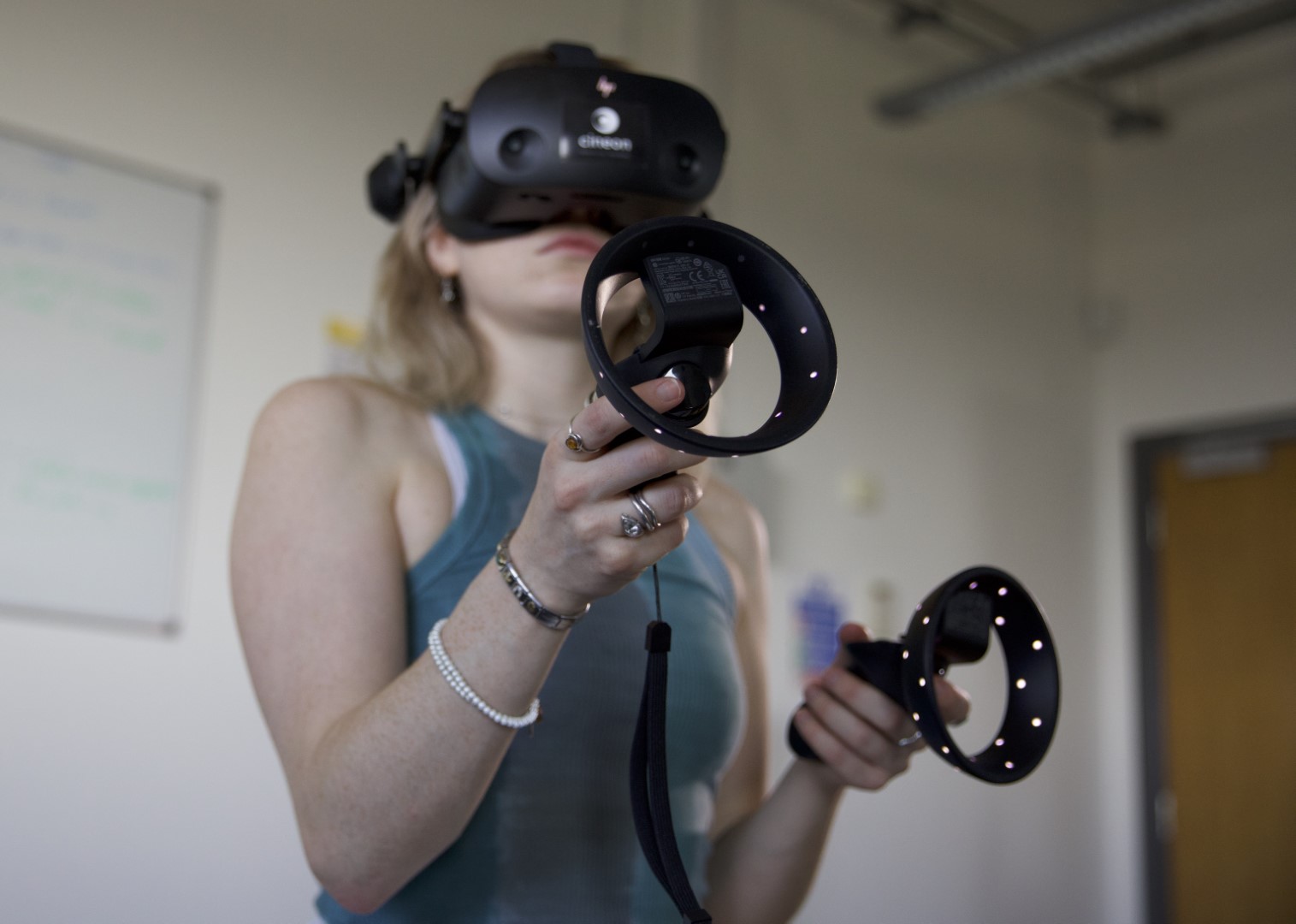
Health tech will save millions: Cineon use artificial intelligence (AI) and eye-tracking to create a range of Virtual Reality (VR) training and therapies that adapt to the psychological state of the user, leading to improved outcomes.
At the core of this work is Cineon’s Empathic Learning Engine (ELE), the company’s foundation-al AI model, which turns human movement data into objective measurements of user emotion, competency and performance. Trained on millions of human interactions, ELE combines advanced machine learning with psychological indexing and a cutting-edge understanding of human performance. Cineon’s expertise is built on many years of research in sectors such as aviation and the military.
In healthcare settings, Cineon is working to help the NHS save millions of pounds each year by reducing missed MRI scanning appointments caused by anxiety. iSAVE (Improving Service Access using Virtual Exposure) is Cineon’s cutting-edge AI-driven virtual reality tool that places patients in immersive environments designed to replicate clinical settings. It monitors anxiety levels in real time and provides gradual, supportive exposure to situations that patients may find stressful, helping to improve comfort and access to care.
Cineon continues to grow at Exeter Science Park, which provides an ideal environment for businesses to expand organically. Being based at the Science Park brings many advantages including a high-quality customer experience supported by high spec facilities such as the café and meeting rooms – which customers expect from a tech company like Cineon.
There are also wider benefits of being part of the innovation community at the Science Park, including on site access to support from SET squared . The “watercooler conversations” are also invaluable, with many companies facing similar challenges, the opportunity to share experience, exchange ideas and collaborate on problem-solving is hugely useful.
Cineon has around 12 permanent staff, bringing together a mix of PHD researchers, software developers and virtual reality specialists, including experienced game designers. The team come from across Devon, with many choosing not to drive to work, instead using public transport or cycling thanks to the well-connected and accessible transport network in and around Exeter.
Toby de Burgh, CEO, said:
“It’s perfect for us – literally just off the motorway so it’s very easy for our customers to get here, as they come from all over the world. Cineon has received Innovate UK funding and plans to progress its software towards clinical trials and broaden its use across different areas of the NHS. The two-year development programme will support further refinement of the technology and help make it more widely applicable within healthcare settings.”